Introduction
“The Japanese have long considered trees to be sacred.”
Many people have heard this phrase, but what lies behind it? Japan has a unique set of beliefs surrounding kodama—tree spirits—and sacred trees found in shrines and forests. Why, then, do the Japanese see trees not merely as plants, but as beings worthy of reverence? This article explores the spiritual relationship between the Japanese and trees, and how it connects to the world of meiboku, Japan’s most treasured woods.
Kodama Spirits — The Idea of Life Dwelling in Trees
1. A culture that senses mysterious forces in the mountains and forests
・An animistic worldview
Japan has long embraced the idea of yaoyorozu no kami—the belief that countless deities inhabit every part of the natural world. Not only rivers and mountains, but even a single tree was thought to house a spirit or divine presence.
・Legends of kodama
Stories of echoing voices in the mountains were attributed to these tree spirits. There are regional tales of certain trees responding to human voices or acting as guardians of the forest.
Such traditions show both awe and closeness toward nature—an attitude deeply rooted in Japanese culture.
2. The feeling of “speaking with trees” deep in the forest
・Trees as more than resources
While trees were valuable materials for tools and homes, the Japanese also saw them as living beings with a spirit of their own.
・A quiet, personal form of prayer
In many regions, people would speak a few words to a tree before cutting it down. This custom reflects the idea that a tree is more than an object—it is a presence to be acknowledged.
Shinboku — Sacred Trees Standing at the Heart of Shrines
1. Sacred trees protecting shrines and communities
・Ancient trees wrapped with sacred ropes
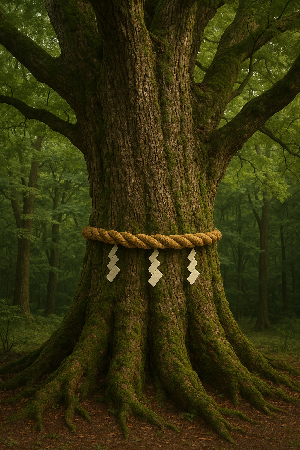
Many shrines feature immense trees encircled with a shimenawa, marking them as sacred. These trees are considered vessels through which deities manifest.
・Symbols of the community
A great tree at the center of a village was believed to watch over the land and its people. Festivals and gatherings often took place beneath such trees. A sacred tree is, in essence, a divine presence open to the community.
2. Why trees become vessels of the divine
・Symbols of longevity and renewal
Trees can live for hundreds or even thousands of years. Their slow, resilient growth evokes mystery and a sense of the eternal.
・A source of life and livelihood
Wood has supported people’s lives in countless ways—housing, tools, heat, and more. Revering trees as sacred beings expresses gratitude for these blessings.
Meiboku — Rare Woods Shaped by Time and Mystery
1. What makes a tree a meiboku?
・Beauty, rarity, and unique grain patterns
Meiboku refers to wood with exceptionally beautiful grain or limited availability due to protected forests and special growing environments.
・A sense of quiet mystery
Many meiboku species possess unusual colors, fragrances, or textures—qualities shaped by centuries of growth.
2. The hidden power formed over centuries
・Trees that have aged for centuries or millennia
Examples include Yakusugi—cedar trees over 1,000 years old—and Jindai cedar, preserved underground for centuries.
Such materials gain a quiet, almost spiritual presence through time itself.
・A craftsman’s reverence
Many artisans approach meiboku with deep respect, feeling that the wood holds a special energy. Some even describe the material as “too great for me,” acknowledging its gravity and history.
Summary — Seeing Wood as More Than Material
- Kodama and sacred tree beliefs reflect Japan’s animistic understanding that spirits dwell in nature.
- Meiboku is closely connected to these beliefs—valued for its rarity, beauty, and the deep time it embodies.
- Japanese culture has long honored wood as a sacred presence, developing refined crafts to bring out its character.
Thus, in Japan, ancient trees are revered not only from a distance but are also brought into daily life as meaningful materials.
Even today, people often feel a quiet depth when encountering old or unusual wood.
Conclusion
The words “kodama” and “sacred tree” may sound like folklore from a distant past. Yet when standing before a great tree wrapped in a sacred rope or a towering cedar deep in the forest, many still sense something beyond words—something close to awe and familiarity.
What makes Japan distinctive is that such reverence doesn’t end in fear or distance. Instead, people have long incorporated these trees into their daily lives as materials to live alongside. Meiboku is a symbol of that cultural relationship.
This sensitivity is not unlike Inuit or Native American cultures, who honor the animals they hunt by using every part with respect. To value a living being, and to use it in order to live together—Japan’s connection to wood carries a similar spirit.
At Manako no Oto, we follow this philosophy by crafting modern objects from rare meiboku. Our goal is to create pieces that feel quietly timeless—special yet naturally at home in daily life— and to share the subtle presence of these remarkable woods.
Feeling something when you look at wood is proof of our long relationship with nature. It is a sensibility worth passing on to future generations. If you are interested in our work, please explore the links below.
▶︎ Gallery|Selected works photographed over the past decade
https://manakonooto.com/gallery/
▶ ONLINE SHOP|Collection of作品 and collaborative works
https://shop.manakonooto.com/en/collections/all