Who Is Bishamonten? His Role and Divine Nature
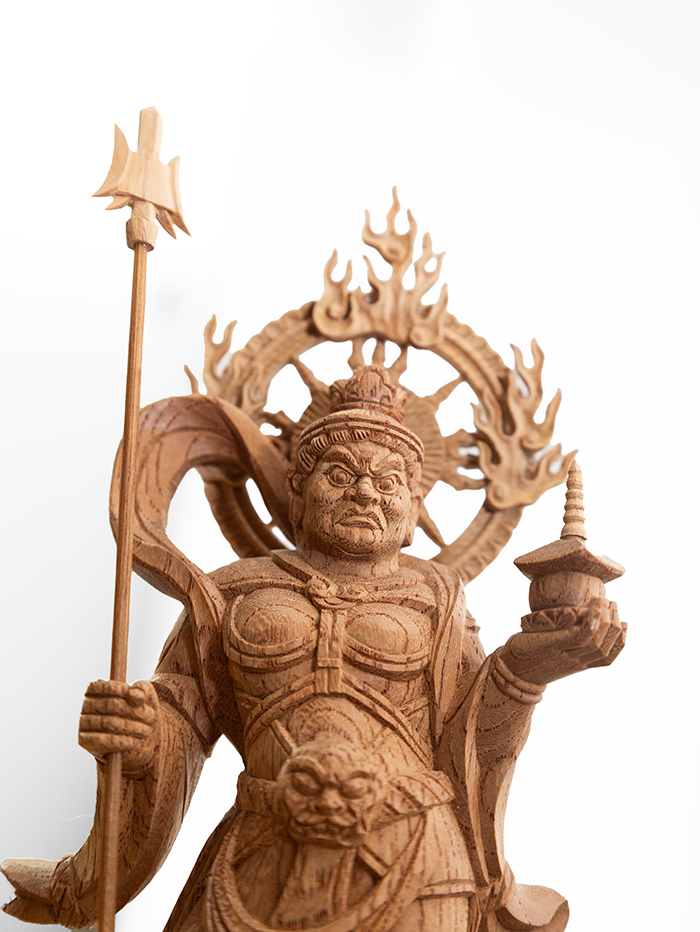
Clad in armor and holding a spear and a sacred pagoda,
Bishamonten stands tall as one of the Seven Lucky Gods.
The only war deity among the benevolent gods, he is revered as the protector of battles and victory.
In ancient India, he guarded the northern direction—considered the most sacred.
In Japan, Prince Shōtoku devoted himself to Bishamonten during the Asuka period (592–710).
This article explores Bishamonten’s origins, historical evolution, blessings, mantras, and sacred syllables, uncovering the deeper meaning behind his essence as a “protector.”
Origins and Transformation: From India to China to Japan
The origin of Bishamonten can be traced back to ancient India, to Kubera—the god of wealth.
As Buddhism spread, Kubera was reinterpreted as Vaishravana, also known as Bishamonten.
Vaishravana, one of the Four Heavenly Kings, serves as the guardian of the north.
The northern direction symbolized wealth, as goods and treasures flowed into India via the Silk Road.
Buddhism later traveled to China via the Silk Road between the 1st century BCE and the 1st century CE, bringing Vaishravana along with it.
From China, Bishamonten arrived in Japan during the Asuka period (592–710).
Emperor Kinmei received Buddhist statues and scriptures from King Seimei of Baekje, marking the official introduction of Buddhism.
Prince Shōtoku enshrined the Four Heavenly Kings in Shitennō-ji and held deep faith in Bishamonten.
During the Sengoku era (1467–1615), warlords worshipped him as a deity of victory.
Why Bishamonten Became the Most Revered War Deity
Japan has many warrior deities—such as Taishakuten, Marishiten, and Idaten—along with the Twelve Heavenly Generals and the Twenty-Eight Attendants.
Yet Bishamonten is by far the most invoked deity in times of war.
Historical figures such as Toyotomi Hideyoshi, Uesugi Kenshin, Takeda Shingen, Prince Shōtoku,
and even Oda Nobunaga and Ōtomo Sōrin prayed to Bishamonten for victory.
Why was Bishamonten chosen over countless other powerful gods?
The most natural explanation is that throughout centuries of warfare, prayers to Bishamonten were believed to be effective.
Just as great figures of the past passed down their stories of divine aid, earlier generations may have had their own compelling accounts.
Blessings and Meaning — A God Who “Protects,” Not Merely One Who Grants Victory
The essence of Bishamonten’s blessings is “protection.”
He repels evil, safeguards what is good, and grants both peace of mind and material abundance.
For those facing hardship, his presence becomes a source of emotional strength and determination.
“Luck in competition,” “prosperity in business,” “financial success,” “warding off misfortune,” “family safety,”
“healing,” “emotional stability,” “achievement of goals,” “safe travel,” “academic success,”
“romantic fulfillment,” “harmonious relationships,” “longevity,” “career success,” “domestic harmony.”
Mantra — Words That Carry the Power of Bishamonten
This sacred mantra is filled with powerful intent. “On” represents a divine vibration, while “Beishiramandaya” calls upon Bishamonten by name.
“Sowaka” means “May it be fulfilled.”
On Beishiramandaya Sowaka
This mantra is believed to draw wishes closer and dispel negative forces.
Reciting it in daily life helps realign the mind and strengthen inner discipline.
In battles or moments of difficulty, this mantra acts like a guiding light, offering courage and clarity.
By chanting with faith, one may truly feel Bishamonten’s protective presence.
Siddham Script — The Sacred Letter of Bishamonten
The Siddham seed syllable for Bishamonten is “Bei.”
This single character represents Vaishravana and symbolizes both protection and prosperity.
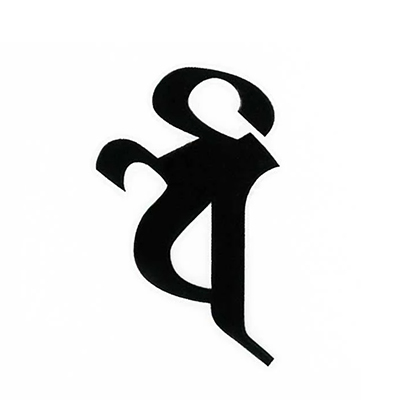
When engraved on wooden plaques, talismans, or seals, the character “Bei” embodies an unshakable spiritual presence.
It steadies the mind of the wearer and may help cut through fear and uncertainty.
Conclusion — True Strength Taught by Bishamonten
Bishamonten is a deity who grants victory.
He eases fear and suffering and breaks the cycle of negativity.
This power creates the conditions for one’s true abilities to emerge—the deeper meaning behind “protection.”
The mantra “On Beishiramandaya Sowaka” holds the force to repel evil and draw blessings closer.
Historical figures such as Uesugi Kenshin and Toyotomi Hideyoshi are said to have recited it before battle.
In life, the path ahead can suddenly disappear, and the distant horizon may darken without warning.
Even in moments that feel hopeless, prayer remains possible.
Just as a single decision on the battlefield could determine life or death,
we too need a spiritual anchor when overwhelmed by uncertainty.
Bishamonten’s courageous stance acts like a compass, revealing the path forward
and awakening our innate intuition.
He does not simply grant victory from the outside—
he draws out what already exists within, cutting through doubt and fear.
In that sense, Bishamonten can be seen as a spiritual compass reminding us of our truest nature.

At Manako no Oto, we offer a small selection of carefully curated Bishamonten statues
that I personally source from China.
Please take a look if this page has brought you here by fate ▼
https://shop.manakonooto.com/en/collections/engimono
p.s.
I once spent a period researching the Seven Lucky Gods in depth.
I went through nearly every book available at my university library—about twenty volumes.
The thickest and most difficult to grasp, by far, was the one on Bishamonten.
《 About Manako no Oto 》
Manako no Oto creates and sells handcrafted wooden items
made from visually distinctive premium hardwoods.
Curated Engimono Collection ▼
▷View Engimono
Please feel free to contact us with any questions.
《 Related Articles 》
• Learn about Bishamonten’s consort, Kisshōten ▼
https://manakonooto.com/engimono/lakshmi/
• Articles on the other Seven Lucky Gods ▼
Hotei / Daikokuten / Ebisu / Benzaiten / Fukurokuju / Jurōjin
《 For First-Time Visitors 》
• About “Manako no Oto” and our products ▼
https://manakonooto.com/products/