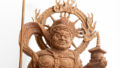
Three Origins – From Mythology to Folk Belief
Ebisu is often depicted holding a large sea bream, wearing a court hat, and smiling warmly with a fishing rod in hand.
So familiar that the phrase “Ebisu smile” exists in Japanese, he is one of the most beloved gods of good fortune.
Traditionally, Ebisu has been especially cherished by people who work with their hands – fishermen, farmers, artisans – as well as those in commerce and trade.
However, his exact origin is not entirely clear.
1. Kotoshironushi-no-kami, a deity described as the son of Ōkuninushi.
2. A folk deity who arose from deifying objects washed ashore from the sea (Ebisu-gami).
3. Hiruko-no-kami, a deity recorded in the ancient chronicles Kojiki and Nihon Shoki.
These three theories are considered the most influential. The prevailing view is that they gradually merged over time into the figure we now know as Ebisu.
The Evolution of Ebisu
According to the tradition of Nishinomiya Shrine, Hiruko, who had been set adrift at sea, washed ashore at Wada Misaki (in present-day Kobe).
He was later enshrined in Nishinomiya and came to be revered as Ebisu.
Today, Nishinomiya Shrine is honored as the head shrine (the “Grand Ebisu”) among the roughly 3,500 Ebisu shrines across Japan.
By the Heian period, Ebisu was worshipped primarily as a guardian deity of fishing.
Coastal communities praised the blessings brought from the sea as Ebisu’s protection and prayed for bountiful catches and safety on the water.
In the Muromachi period, as commerce flourished, the character of Ebisu’s worship began to change.
He evolved from a protector of fishermen into a guardian of markets and trade, and was chosen as one of the Seven Lucky Gods.
From this time on, the familiar image of a joyful Ebisu holding a sea bream and fishing rod began to appear in statues and paintings.

Source: Nishinomiya Shrine website
(https://nishinomiya-ebisu.com/about/)
What Kind of God of Good Fortune Is Ebisu?
Ebisu’s representative blessings include “prosperity in business,” “bountiful catches at sea,” “abundant harvests,” and “success at work.”
He is revered as a symbol of the belief that “those who work honestly and earnestly will surely be blessed.”
The sea bream he holds is not only a play on words with “medetai” (auspicious), but also a symbol of abundant catch and livelihood.
His gentle smile represents “the satisfaction that follows sincere effort.”
Ebisu is not a god of sudden windfalls, but a deity who cherishes steady, grounded prosperity.
“Good fortune comes to those who keep doing their best.”
This teaching still speaks directly to us today.
Mantra / Sacred Chant
Ebisu has also been venerated within Esoteric Buddhist traditions.
Although he is the only one among the Seven Lucky Gods who originates from Japan, he came to be associated with Buddhism and thus has his own mantra.
On Indaraya Sowaka
This is the sacred mantra of Ebisu.
It carries the wish “to bring abundant blessings and help trade and business flourish.”
Sacred Script – The Siddham Character of Ebisu
The Siddham character (seed syllable) most commonly associated with Ebisu is “I,” a sacred letter symbolizing blessing and prosperity.

Siddham characters are prayers given form. Wearing them, keeping them close, or simply gazing at them is itself considered an act of devotion.
Blessings and Benefits (Goriyaku)
Ebisu-sama
As a deity of the sea’s bounty and the prosperity of trade, Ebisu protects fishing, commerce, and family businesses as a whole, inviting good fortune and virtue with compassionate care.
He is believed to kindle a sense of joy and abundance in the heart.
Abundant catches at sea, prosperity in business, safety at sea, safety for the household, improved financial luck,
good fortune and protection, academic success, rich harvests, matchmaking and good relationships, warding off evil and misfortune,
safe voyages, thriving markets, god of trade, god of fishermen, laughter and happiness,
fulfillment of wishes, career advancement, flourishing family fortunes, attracting wealth and good luck.
Ebisu – A Uniquely Japanese God of Good Fortune | Blessings of Sea and Land
Rather than simply “granting wishes,” Ebisu is often understood as a deity who helps create an environment where sincere effort can bear fruit.
He is a god of good fortune who brings blessings and opportunities when we “work honestly and wish sincerely.”
Since references to him appear in ancient texts such as the Kojiki and Nihon Shoki, Ebisu worship has continued for at least 1,300 years.
Today, he is still widely revered as a popular god of good fortune, often enshrined together with Daikoku as “Ebisu-Daikoku.”

At Manakonooto, we offer a small selection of carefully chosen Ebisu statues that I personally source on trips to workshops in China.
Because each piece is handpicked and stocks are limited, items may sell out from time to time.
Please feel free to browse the collection while they are available ▼
https://shop.manakonooto.com/en/collections/engimono
Although Ebisu is a Japanese-born god of good fortune, together with Daikoku he is also known and cherished in parts of China.
If you have found your way to this page, I hope you will enjoy exploring these works as part of that special connection.
p.s
I make a habit of visiting Nishinomiya Shrine for the Tōka Ebisu Festival each year.
The “Lucky Man Race,” in which worshippers dash through the shrine gates at opening, is particularly famous.
At Nishinomiya Shrine, both “Ebisu-son” and “Ara-Ebisu-son,” a more austere aspect of Ebisu, are enshrined.
Just as Daikoku has both gentle and fearsome aspects, Ebisu too has a side that differs from his familiar smiling image.
We also carry several auspicious wooden works created by contemporary Buddhist sculptor Eiichi Ihara, whose Ebisu statue has been formally dedicated to Nishinomiya Shrine, including pieces of “Hotei,” “Phoenix,” and “Dragon.” ▼
https://shop.manakonooto.com/en/collections/select-goods
If you are interested, please take a look.
《 About Manakonooto 》
At Manakonooto, we create and sell small wooden objects made from visually distinctive Japanese hardwoods.
Curated Fortune Figures ▼
▷View Fortune Figures
If you have any questions, please feel free to contact us.
《 Related Articles 》
・Articles on the Seven Lucky Gods ▼
Hotei /
Daikokuten /
Ebisu /
Benzaiten /
Fukurokuju /
Jurojin /
Bishamonten
《 Related Products 》
・Fortune Figure Collection ▼
https://shop.manakonooto.com/en/collections/engimono
《 For First-Time Visitors 》
・About Manakonooto and our products ▼
https://manakonooto.com/products/