

A bald head, gentle smile, and welcoming presence.
Known across China, Korea, Japan, and Southeast Asia—and now familiar throughout the Western world—the “Laughing Buddha” is one of the most beloved symbols of happiness and good fortune.
But few people know that this joyful figure was inspired by a real historical person.
He is believed to trace back to a 10th-century Chinese Chan (Zen) monk named Kaishi (契此), who lived during the final years of the Tang Dynasty.
Ancient biographies describe Kaishi as a wandering monk who traveled through the Siming Mountains in present-day Ningbo, Zhejiang Province.
Wherever he went, he lifted people’s spirits—offering comfort not by preaching, but simply by sharing laughter.
These stories appear in texts over a thousand years old, including:
- 988: Song Gaoseng Zhuan (Biographies of Eminent Monks)
- 1004: Jingde Chuandeng Lu (Record of the Transmission of the Lamp)
Both works portray Kaishi as unconventional and free-spirited—someone who lived outside the strict monastic hierarchy of his time. His presence represented a different expression of Zen, one grounded in humility, approachability, and everyday kindness.

Before his passing, he is said to have spoken these mysterious words:
“I am Maitreya. Maitreya appears in a thousand billion forms.”
In China, he later came to be known as “Da Du Mile” (the Great-Bellied Maitreya).
In Japan, he evolved into Hotei, one of the Seven Lucky Gods.
And in the West, he is widely cherished as the Laughing Buddha, a figure whose joyful spirit has transcended cultures for over a millennium.
From Zen Monk Kaishi to Hotei: A Cultural Journey
The earliest historical references to Hotei appear in:
- 988: Song Gaoseng Zhuan, Volume 21 — A biography compiled within decades of Kaishi’s lifetime, based on oral tradition.
- 1004: Jingde Chuandeng Lu, Volume 27 — An imperially sanctioned record of Zen lineages.
These texts describe him as a monk who lived outside formal structures. This “outsider” image may have been used to emphasize a core Zen idea: awakening is not limited to rank or status—it can arise in the most ordinary moments.
Interestingly, in modern China he is still commonly referred to not as “Hotei” but as Maitreya, the future Buddha.
A Verse Left by Kaishi Before His Death
(In Buddhist literature, short poetic verses—called “gathas”—are used to express teachings in a memorable, concise form.)
Maitreya, the true Maitreya
Appears in a thousand billion forms
Present in every moment and every place
Yet people fail to recognize him
Many scholars interpret this poem as Kaishi’s self-revelation: that he embodied the qualities of Maitreya, manifesting in countless forms of kindness that people often overlook.
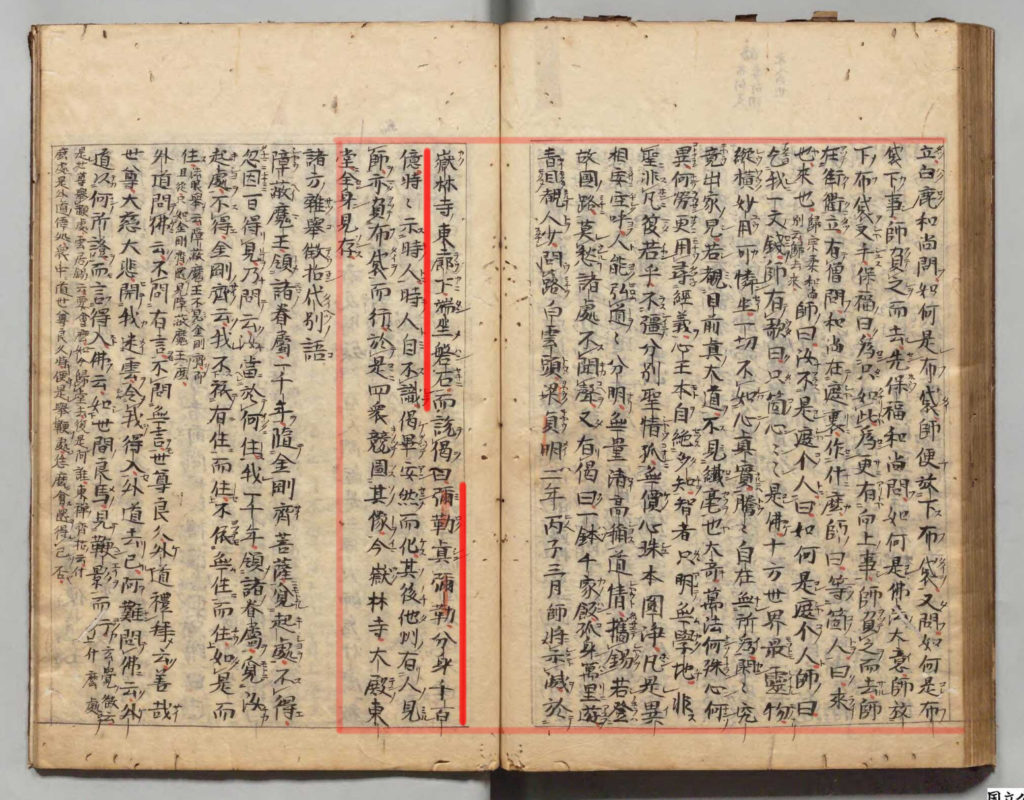
Full English translation of the Hotei chapter:
https://manakonooto.com/engimono/hotei-literature-b/
Why Is This Verse Interpreted as Referring to Hotei?
- The structure “A, the true A” is typically used in classical Chinese for self-identification. If referring to someone else, a different expression would be used.
- The phrase “a thousand billion forms” is a traditional Buddhist expression describing a Buddha’s limitless manifestations.
For these reasons, the verse has long been understood as indicating Hotei = Maitreya.
Sacred Mantra
Because Hotei is seen as an embodiment of Maitreya Bodhisattva, the mantra associated with him is:
On Maitareiya Sowaka
- On — a sacred syllable used in many Buddhist mantras
- Maitareiya — the name of Maitreya Bodhisattva
- Sowaka — a Sanskrit blessing meaning “May it be fulfilled”
This mantra is recited as a prayer to invite the compassion and hope of the future Buddha into the present moment.
Sanskrit Seed Syllable (Bīja)
The sacred syllable associated with Hotei is “Yu”, representing Maitreya Bodhisattva.
This character is also connected to ideas of union and integration—a reminder that spiritual harmony begins with a centered, peaceful heart.

Sanskrit seed syllables are often described as “prayers made visible.”
Wearing them or contemplating them is considered a form of devotion and reflection.
Blessings
Hotei the Smiling Deity
A symbol of joy, generosity, and emotional ease. He is believed to gather people’s worries into his large cloth bag, softening them with laughter and goodwill.
Blessings Commonly Associated with Hotei:
- Good fortune and prosperity
- Happiness and emotional well-being
- Success in work and business
- Financial blessings and household safety
- Harmony in family and relationships
- Academic achievement and safe childbirth
- Health, longevity, and protection from illness
- Wish fulfillment and spiritual protection
- Good social connections and defense from misfortune
Final Reflections
Hotei conveys a simple but enduring message:
“Place a smile in your own heart first. Harmony begins there, and harmony invites good fortune. When shared, it becomes happiness for others.”
His round belly symbolizes inclusiveness; his large cloth bag represents generosity; his smile is an invitation to relax our worries.
Although a thousand years have passed since Kaishi walked the Siming Mountains, his spirit of warmth and kindness still resonates today.
Maitreya—the Buddha of the future—is said to appear quietly, through compassion rather than spectacle.
Perhaps a single smile we offer today may ease someone’s burden tomorrow.
Through his enduring image, Hotei continues to remind us of this timeless truth.
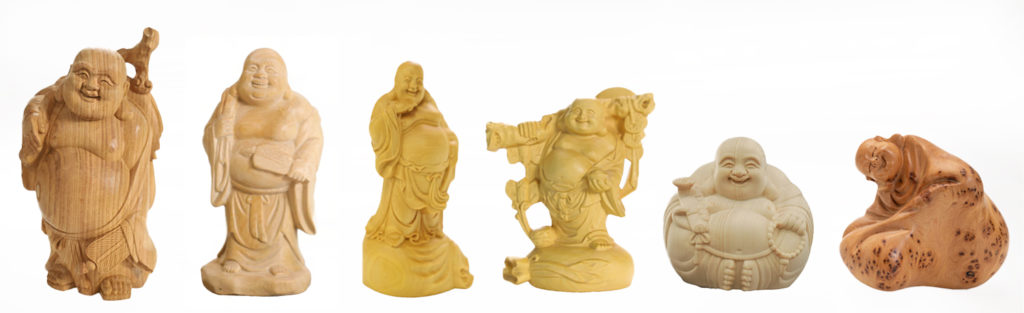
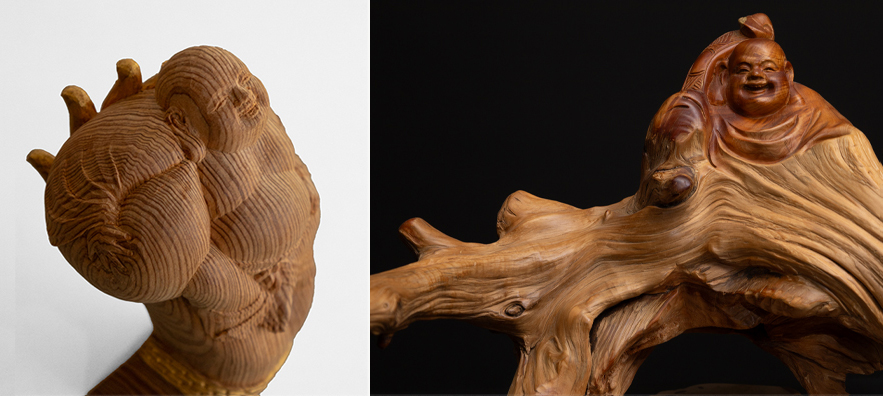
At Manakonooto, we travel to China—renowned for its long tradition of Buddhist sculpture—to personally select a limited number of Hotei statues.
Please note that availability may vary, as each piece is chosen with great care.
We invite you to explore our curated collection:
[Lucky Charms | Product List]
We hope your visit to this page becomes a meaningful connection.
P.S.
While creating this article, I explored original historical sources on Hotei and found that several ancient texts are available online.
One such source:
Song Gaoseng Zhuan
《 About Manakonooto 》
At Manakonooto, we design and offer handcrafted items made from distinctive, rare hardwoods.
We also curate auspicious talismans crafted with care and meaning.
[View Our Lucky Charms Collection]
If you have any questions, please feel free to contact us.
《 Related Articles 》
・Learn more about the Seven Lucky Gods:
Hotei 布袋尊 /
Daikokuten 大黒天 /
Ebisu 恵比寿尊 /
Benzaiten 弁才天 /
Fukurokuju 福禄寿 /
Jurōjin 寿老人 /
Bishamonten 毘沙門天
《 Related Products 》
・View All Lucky Charms:
https://shop.manakonooto.com/en/collections/engimono
《 For First-Time Visitors 》
・About our products:
https://manakonooto.com/products/
